
What Is Creative Thinking?
Creative thinking is the ability to look at a question, situation or problem from different perspectives and develop ideas that are useful, original or different from the obvious answer. For children, it is not limited to drawing, painting, storytelling or music. A student can demonstrate creative thinking while finding another way to solve a mathematics problem, designing a simple science experiment, developing a story, suggesting a solution to a community issue or asking a question that makes the whole class stop and think. The OECD describes creative thinking as the capacity to generate diverse and original ideas and to evaluate and improve ideas, showing that creativity is closely connected with thinking and problem-solving rather than being restricted to the arts. For parents, this distinction matters because a child does not have to be naturally artistic to be creative. What matters is whether the learning environment gives the child opportunities to explore possibilities, make connections, question assumptions and improve ideas. In a rapidly changing world, those habits can become valuable foundations for lifelong learning.
Creative Thinking Is More Than Artistic Talent
It is easy to associate creativity with children who love colours, music, crafts or storytelling, but that is only one part of the picture. Creative thinking in students can appear in almost every subject and everyday situation. Consider a child who notices that a particular classroom activity could be done differently and suggests an alternative. Another student may read a story and imagine a completely different ending. A young science learner may wonder what would happen if a familiar experiment were changed in one small way. These are all examples of children moving beyond simply receiving information and beginning to work with it actively. The OECD’s PISA framework similarly treats creative thinking as something that can be applied to imagination, communication and problem-solving tasks rather than only artistic expression. This is why schools have an important role to play. When students are encouraged to ask “What else could work?” instead of only “What is the correct answer?”, the classroom becomes a place where curiosity has room to grow. The goal is not to make every child think alike, but to help each learner become comfortable exploring more than one possibility.

Why Creative Thinking Matters in Education
Education is no longer simply about remembering information long enough to reproduce it in an examination. Children need knowledge, of course, but they also need to know what to do with that knowledge when they encounter an unfamiliar situation. Creative thinking skills can support this process by encouraging students to make connections, consider alternatives and develop ideas. This does not mean that creativity replaces academic foundations. In fact, OECD PISA 2022 findings show a complementary relationship between creative thinking and core academic domains, while also indicating that academic excellence is not a prerequisite for excellence in creative thinking. For parents choosing a school, this is an important consideration. A strong educational environment should provide children with opportunities to build subject knowledge while also using that knowledge in meaningful situations. Whether a student is working with numbers, language, science, social studies or technology, there should be opportunities to question, apply, design, discuss and improve. Creative learning therefore works best when it is woven into everyday education rather than treated as an occasional special activity.
Building Better Problem-Solving Skills
One of the clearest benefits of creative thinking is that it can change how students approach problems. Imagine giving two children the same challenge: they both understand the problem, but one immediately searches for the expected method while the other asks whether there might be another route. Neither approach is automatically better, but the second child is beginning to practise flexibility in thinking. Creative problem-solving encourages students to identify a challenge, generate possible solutions, examine those ideas and make improvements.
The OECD’s creative thinking assessment specifically included open-ended problem-solving contexts in which students had to generate diverse ideas rather than simply select a predetermined answer. This kind of thinking can be encouraged through classroom discussions, design activities, investigations and projects. It also helps children understand that an unsuccessful attempt is not necessarily wasted effort. Sometimes the first idea is simply a stepping stone towards a stronger one. When students learn to revise rather than immediately give up, they begin to see problems as opportunities for discovery.
Encouraging Curiosity and Independent Thought
Curiosity is often the spark behind creative thinking. A child who keeps asking “Why?”, “How?” and “What if?” is already beginning to explore beyond the information directly provided. Schools can nurture this natural curiosity by treating questions as valuable parts of learning instead of interruptions to a fixed lesson plan. Students should have opportunities to investigate topics, express opinions, compare possibilities and explain their reasoning. UNICEF also highlights creativity, problem-solving and critical thinking among skills that education systems need to support as children prepare for a changing world. At home, parents can support the same habit by resisting the temptation to provide an immediate answer to every question. Sometimes asking, “What do you think?” or “How could we find out?” gives a child a much richer learning experience. Over time, these small moments can encourage independence. The child begins to understand that learning is not simply something that happens when an adult provides information; it is also something the learner actively participates in.
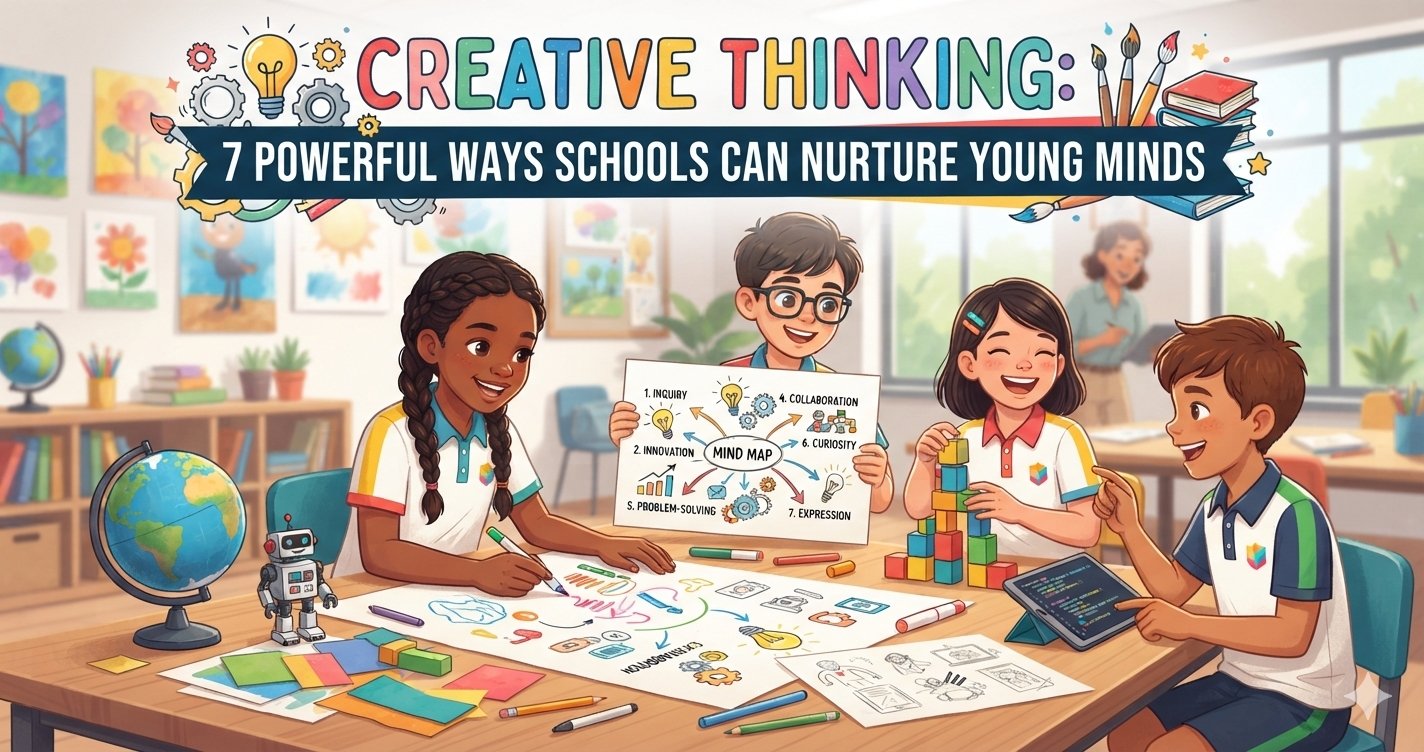
7 Practical Ways to Develop Creative Thinking
1. Encourage Open-Ended Questions
Open-ended questions are among the simplest tools for developing creative thinking in students because they allow more than one reasonable response. Instead of asking a child to remember a single fact, teachers and parents can ask questions such as, “What might happen if we changed this?”, “Can you think of another solution?”, “Why do you think this happened?” or “How would you explain this to someone younger than you?” Such questions encourage children to organise their knowledge and use it in new ways. They also make classroom conversations more dynamic because students can hear different perspectives from their peers. The objective is not to make every response correct or equally strong; it is to create a process in which children can propose, evaluate and improve ideas. Over time, students become more comfortable sharing thoughts that are still developing. That confidence matters because creative ideas rarely arrive perfectly formed. A classroom where thoughtful experimentation is welcomed can help children understand that changing an idea after receiving feedback is a normal part of learning.
2. Use Project-Based Learning
Project-based learning gives students a reason to apply what they know. Instead of studying a concept in isolation and moving immediately to an assessment, students can use knowledge from different areas to complete a meaningful task. A project might involve researching water conservation, designing a model, creating a presentation, developing a simple awareness campaign or investigating a local environmental question. The process naturally requires planning, questioning, collaboration, decision-making and revision. UNICEF’s work around hands-on and experiential learning similarly emphasises creative problem-solving, collaboration and design-thinking approaches that allow learners to work through real challenges. Project-based learning also gives students different ways to demonstrate understanding. One child may contribute through research, another through visual design, another through communication and another through technical problem-solving. Rather than asking every student to demonstrate learning in exactly the same way, projects can reveal different strengths while still maintaining clear learning goals.
3. Give Children Space to Experiment
Creativity needs room to breathe. When every classroom task has one tightly controlled method, children may become reluctant to try something different because they are worried about making a mistake. Experimentation changes that dynamic. Students can be encouraged to test an idea, observe what happens, discuss the outcome and make a second attempt. This process can be particularly useful in science, technology, art, design and practical activities, but the underlying principle can be applied across subjects. Teachers do not need to remove structure; they can provide boundaries within which students have choices. For example, a teacher may establish the learning objective and available materials while allowing students to decide how they will approach the challenge. Parents can create similar opportunities with everyday activities such as building objects from recyclable materials, preparing a simple recipe, rearranging a room or inventing a game. The important lesson is that experimentation is not synonymous with failure. It is a way of collecting information. When children learn to ask what an unsuccessful attempt has taught them, they become more willing to continue exploring.
4. Connect Different Subjects
Some of the most interesting ideas appear when children connect concepts that are usually taught separately. Mathematics can connect with art through patterns and symmetry. Science can connect with language through explanation and storytelling. Geography can connect with design through maps, models and sustainability projects. Technology can connect with social studies when students explore how digital tools influence communities. These connections encourage learners to see knowledge as an interconnected network rather than a collection of isolated boxes. Creative thinking benefits from this kind of cross-disciplinary learning because students can transfer an idea from one context into another. A pattern discovered in mathematics may inspire an artistic design; a story about a community problem may lead to a science investigation; a historical event may inspire a debate about modern challenges. For parents comparing schools in Bengaluru or Kanakapura, it is useful to ask whether learning extends beyond textbook chapters. A school environment that encourages students to connect ideas across subjects can give them more opportunities to practise flexible and original thinking.
5. Encourage Collaboration and Discussion
Creative thinking does not always happen alone. Sometimes another person’s question is the missing piece that helps an idea develop. Group discussions and collaborative projects allow students to listen to different viewpoints, explain their own reasoning and build on suggestions from others. Edify School’s academic approach describes classroom experiences that encourage students to participate in discussions, work together creatively to solve problems and communicate their ideas. This type of interaction can be especially valuable because children learn that disagreement does not necessarily mean conflict. Two students may have different solutions, compare their reasoning and eventually combine the strongest elements of both ideas. Teachers can guide these conversations by asking students to explain why they think something will work rather than simply asking which answer they prefer. Parents can reinforce this at home by discussing everyday decisions with children and inviting them to suggest alternatives. Collaboration teaches an important creative habit: an idea can become stronger when it is questioned, tested and improved by others.
6. Make Reflection Part of Learning
Creative thinking is not only about producing ideas; it also involves evaluating and improving them. Reflection gives students a chance to look back at their work and ask what worked, what did not and what they would change next time. A simple reflection after a project can reveal a great deal. A student might realise that the original plan was too complicated, that a different material would have worked better, or that another person’s suggestion improved the final result. The OECD’s definition of creative thinking includes evaluating and improving ideas, making reflection an important part of the process rather than an optional final step. Teachers can use short reflection questions, learning journals, peer feedback or classroom discussions. Parents can ask similar questions after homework or activities: “What was the hardest part?”, “What would you change?”, and “What did you discover?” These questions encourage children to see learning as a cycle. Think, try, review, improve and try again. That mindset can be more valuable than getting everything perfect on the first attempt.
7. Connect Learning With Real-World Problems
Children are naturally interested in problems they can see, understand and influence. A lesson about waste becomes more meaningful when students investigate waste in their own surroundings. A mathematics lesson can become practical when students plan a small budget or compare quantities. A language activity can involve creating an awareness message for a real community issue. Real-world contexts provide a reason for students to use knowledge creatively. They also make it easier for children to understand why learning matters outside examinations.
Edify School’s published information describes inquiry-based and community-oriented learning opportunities, including student-led outreach and sustainability activities. These experiences can give learners a chance to combine knowledge, creativity, communication and responsibility. The key is to choose age-appropriate challenges. A young child does not need to solve a complex global issue. Even a small classroom question—such as how to reduce paper waste or make a shared space more useful—can become an opportunity for creative problem-solving.
How Parents Can Encourage Creative Thinking at Home
Parents do not need expensive equipment or elaborate activities to encourage creative thinking. Everyday life provides plenty of opportunities. Cooking can become a lesson in measurement and experimentation. A walk can turn into an observation exercise. A storybook can lead to a discussion about alternative endings. Household objects can become materials for building, sorting or designing. Even conversations at the dinner table can encourage children to consider different perspectives. The most useful habit may simply be giving children enough time to think before stepping in with a solution. Parents can also praise the process rather than only the result. Saying, “I like how you tried a different approach” sends a different message from simply saying, “You got the right answer.” Children gradually learn that thoughtful effort, curiosity and improvement have value. If parents and schools reinforce similar habits, children receive a consistent message: their ideas matter, and learning is not limited to memorising what someone else has already discovered.
Simple Everyday Activities
Try activities that have multiple possible outcomes rather than a single answer. Ask your child to find several uses for an everyday object, invent a short story from a random picture, design a paper structure that can hold a small object, create a new rule for a familiar game or suggest ways to make a household routine easier. These activities can be adapted to different ages and abilities. The goal is not to judge how impressive the final idea is. Instead, ask the child to explain the thinking behind it. This creates an opportunity to practise communication alongside creativity.
Parents can also introduce a “what if” question during ordinary conversations: What if the school day started differently? What if we had to save water for one week? What if you had to explain this topic without using words? Such prompts turn ordinary moments into small thinking exercises. Over time, these conversations can help children become more comfortable exploring possibilities instead of waiting for adults to provide the expected answer.
Common Mistakes That Can Limit Creativity
What Parents and Schools Should Avoid
One common mistake is treating creativity as something that should always produce a polished result. Children may become hesitant to experiment if they believe every drawing, project or answer must look perfect. Another mistake is praising only children who produce unusual ideas while ignoring the effort involved in developing and improving an idea. Excessive comparison can also discourage creative risk-taking because students may focus on outperforming classmates rather than exploring possibilities. A further problem occurs when adults provide solutions too quickly. If a child asks how to complete a task and receives the answer immediately, an opportunity for independent thinking disappears. None of this means that structure, assessment or academic standards should be removed. Children need knowledge and guidance. The balance lies in combining clear learning goals with enough flexibility for students to question, experiment, discuss and revise. A thoughtful school should therefore look beyond whether creative activities exist and consider whether students genuinely have opportunities to think for themselves.
How to Choose a School That Supports Creative Thinking
What Parents in Bengaluru and Kanakapura Can Look For
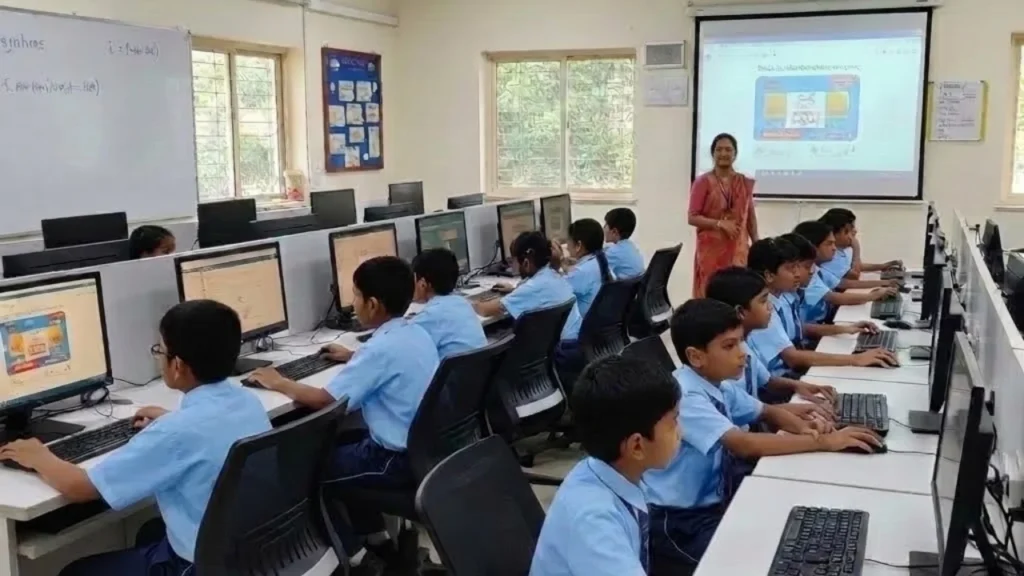
Parents exploring schools in Bengaluru or schools in Kanakapura can look for practical signs that creativity is part of everyday learning. During a school visit, ask how students participate in lessons, how projects are designed and whether children are encouraged to explain their reasoning. Look at classrooms and student work, but do not focus only on attractive displays. Ask whether students have opportunities to conduct investigations, collaborate, present ideas and learn from mistakes. It can also help to understand the school’s curriculum philosophy, extracurricular opportunities, laboratories, learning resources and approach to technology. Edify School’s published information describes facilities including a library, wonder rooms, music rooms, English, mathematics and science laboratories, along with technology-supported learning. Parents should also consider practical factors such as location, communication, student support, age-appropriate activities and whether the learning environment aligns with their child’s needs. There is no single school model that is perfect for every child. The right choice is one that combines academic foundations with an environment in which the child can remain curious, engaged and willing to explore.
How Edify School Supports Holistic Learning
Learning Through Creativity, Curiosity and Exploration
For families considering Edify School in Bengaluru, the school’s published academic approach provides several points relevant to creative development. Its 3C framework describes Content, Competence and Character, while its published profile of the curriculum identifies a “Creative” learner as one who can create and display novel ideas resulting from originality of thought. The school also describes workshops focused on Creative & Critical Thinking, alongside activities such as improvisation and other programmes designed to expose students to different ways of perceiving and navigating the world. These elements are relevant because creativity develops through repeated opportunities, not through one isolated lesson. Parents can explore how these approaches fit their child’s learning needs, age and interests before making a school decision. For families near Kanakapura Main Road, understanding the school’s learning philosophy can be as important as considering academic subjects. A school should provide children with strong foundations while also giving them opportunities to ask questions, communicate ideas, collaborate and solve problems. Parents interested in the admission process can review the school’s current admissions information and make an enquiry directly.
Conclusion: Helping Children Think Beyond the Expected
Creative thinking is not an extra skill that children only need for art, competitions or special projects. It is a way of approaching learning that can help students generate ideas, consider alternatives, solve unfamiliar problems and improve their work. Research from the OECD shows that creative thinking can be assessed as a distinct capability and that strong creative thinking can coexist with strong academic performance; academic excellence is not, however, a prerequisite for creative thinking excellence. For parents, the practical takeaway is simple: look for environments where children are encouraged to ask questions, experiment, collaborate, connect ideas and reflect on their learning. Whether you are exploring education options in Bengaluru, Kanakapura or elsewhere in Karnataka, consider how a school develops the whole learner rather than focusing only on marks. Edify School provides an example of an educational environment that highlights creativity, inquiry, collaboration and holistic development. If you would like to understand whether the school is suitable for your child, you can enquire about the admission process and speak with the school team.
I. FAQ section
1. What is creative thinking in education?
Creative thinking in education is the ability to generate different ideas, consider alternative approaches and develop or improve solutions. It can be used across subjects, including mathematics, science, languages, social studies, technology and the arts. It is not limited to artistic ability.
2. Why is creative thinking important for students?
Creative thinking helps students approach unfamiliar situations with flexibility. It encourages them to ask questions, explore possibilities, solve problems and improve ideas. OECD research also indicates that creative thinking and academic performance can complement each other, while academic excellence is not a prerequisite for creative thinking excellence.
3. How can parents develop creative thinking at home?
Parents can encourage creativity through open-ended questions, storytelling, building activities, games, household projects and discussions. Asking children to suggest more than one solution is particularly useful. Giving them time to think independently can also encourage confidence and curiosity.
4. Is creative thinking only useful for artistic children?
No. Creative thinking applies to many areas beyond art. A child can demonstrate creativity by finding another way to solve a mathematics problem, developing a science experiment, explaining a concept differently or suggesting a solution to an everyday problem.
5. How do schools develop creative thinking skills?
Schools can use project-based learning, open-ended questions, group discussions, experiments, interdisciplinary activities, reflection and real-world problem-solving. A supportive classroom also gives students opportunities to test ideas and learn from mistakes.