

Education is no longer only about remembering lessons, completing assignments and scoring well in examinations. While strong academic knowledge remains important, children also need to know how to think, communicate, solve problems and work with others.
This is why 21st Century Skills have become an important part of modern education.
Children today are growing up in a world that is changing quickly. Technology is influencing how people learn and work, information is available at their fingertips, and many future careers may require skills that go beyond traditional academic knowledge.
For parents, the challenge is understanding which abilities really matter and how schools can help children develop them.
From critical thinking and creativity to communication, collaboration and adaptability, these skills can help students become more confident and independent learners.
For example, Edify School in Bengaluru follows a 3C Curriculum built around Content, Competence and Character, bringing academic learning together with broader areas of student development.
What Are 21st Century Skills?
21st Century Skills are practical abilities that help students use their knowledge effectively in school, everyday life and future situations.
They are not a replacement for academic subjects. Instead, they work alongside subjects such as mathematics, science, languages and social studies.
A child may know how to solve a mathematical equation, for example. But understanding why the solution works, explaining it to someone else and finding another way to approach the problem involve additional skills.
Similarly, knowing information is valuable, but being able to question it, evaluate it and use it appropriately is equally important.
Why Do Students Need These Skills?
Developing these abilities can help children:
- Think carefully before making decisions
- Express their thoughts more clearly
- Work comfortably with different people
- Approach unfamiliar problems
- Respond to changes with greater confidence
- Use technology responsibly
- Become more independent learners
- Understand different points of view
These abilities are also closely connected. A student working on a group project may need communication, creativity, critical thinking, collaboration and problem-solving at the same time.
1. Critical Thinking
Critical thinking is one of the most important 21st Century Skills students can develop.
Children encounter information everywhere — in classrooms, books, conversations, websites and digital platforms. They therefore need to learn that not every piece of information should simply be accepted.
Critical thinking encourages students to ask questions, examine evidence, compare ideas and form their own reasoned conclusions.
How can children develop critical thinking?
Parents and teachers can ask questions such as:
- Why do you think this happened?
- What makes you believe that?
- Is there another possible explanation?
- What would happen if we changed one part of the situation?
Simple conversations like these can encourage children to explain their thinking rather than simply provide an answer.
Classroom discussions, experiments, debates, projects and open-ended activities can provide further opportunities to practise these skills.
2. Communication
A student may have a great idea, but being able to communicate that idea clearly is an important part of learning.
Communication involves much more than speaking. It includes listening, reading, writing, presenting ideas and understanding how to communicate with different people.
Students can develop communication skills through:
- Classroom presentations
- Storytelling
- Group discussions
- Writing activities
- Debates
- Team projects
- Public speaking opportunities
Good communication also means learning to listen.
When children learn to hear another person’s viewpoint before responding, they can become better collaborators and more thoughtful participants in conversations.
3. Collaboration and Teamwork
Many challenges in real life require people to work together.
Collaboration skills help students understand how to contribute to a group while respecting the ideas and responsibilities of others.
A group project, for example, may require students to divide tasks, share information, resolve disagreements and work towards one outcome.
The experience teaches an important lesson: working as a team does not mean that everyone has to think in exactly the same way.
Different perspectives can actually improve a solution.
Schools can encourage teamwork through group assignments, sports, classroom activities, projects and other collaborative learning experiences.
4. Creativity and Innovation
Creativity is sometimes associated only with drawing, music or performing arts. In reality, creative thinking can be useful in almost every subject.
A creative student may look at a familiar problem and ask:
“Is there another way to solve this?”
That willingness to explore different possibilities can be valuable in mathematics, science, languages, technology and everyday situations.
Schools can encourage creativity through:
- Art and design
- Story writing
- Experiments
- Project work
- Model making
- Drama and performing arts
- Open-ended assignments
- Innovation activities
The aim is not for every child to produce the same answer. It is to give them room to explore ideas and understand that a problem can sometimes have more than one reasonable approach.
5. Problem-Solving
Children encounter small problems every day.
They may have to decide how to complete a project, resolve a disagreement with a friend or work out why an experiment did not produce the expected result.
These situations can become learning opportunities.
Problem-solving skills help students break a challenge into manageable parts and think about possible solutions.
A simple process might involve:
- Understanding the problem
- Identifying what is causing it
- Thinking of possible solutions
- Comparing the options
- Trying a solution
- Reflecting on what happened
This process can help children become less dependent on someone else immediately providing the answer.
6. Digital Literacy
Technology is now a normal part of education and everyday life. Students therefore need more than basic knowledge of how to use a computer, tablet or smartphone.
Digital literacy means understanding how to use digital tools thoughtfully and responsibly.
Students should gradually learn how to:
- Search for information
- Check whether information is reliable
- Communicate responsibly online
- Protect personal information
- Use digital tools for learning
- Understand appropriate online behaviour
Parents can support this learning by discussing what children encounter online rather than simply setting rules around technology.
Technology can be a useful learning tool, but children also need judgement about when and how to use it.
7. Adaptability and Flexibility
Change is part of life.
Students may move into a new class, meet different teachers, encounter unfamiliar subjects or face problems that do not have an obvious answer.
Adaptability helps children respond to these situations without giving up when something does not go according to plan.
Instead of thinking, “This isn’t how I expected it to happen,” an adaptable student can begin asking:
“What can I try next?”
Teachers can encourage adaptability by introducing new experiences, allowing students to explore different approaches and helping them reflect on mistakes.
Learning that mistakes are part of the process can make children more comfortable with trying something unfamiliar.
8. Emotional Intelligence and Empathy
Academic development is important, but children also need to understand themselves and the people around them.
Emotional intelligence involves recognising emotions, managing them appropriately and understanding how our behaviour can affect others.
Empathy adds another important dimension: trying to understand how another person may feel or see a situation.
Students can gradually develop these abilities by learning to:
- Listen to others
- Express emotions appropriately
- Recognise different feelings
- Respect different opinions
- Handle disagreements calmly
- Consider another person’s perspective
These skills can support healthier relationships and make group learning more productive.
9. Self-Management and Lifelong Learning
One of the most useful 21st Century Skills is learning how to take responsibility for your own learning.
Self-management includes skills such as:
- Setting goals
- Organising tasks
- Managing time
- Staying focused
- Completing responsibilities
- Reflecting on progress
Of course, children should not be expected to manage everything independently from a young age.
Parents and teachers can gradually increase responsibility as children mature.
A younger student might begin by organising their school bag. Later, they may plan homework, manage deadlines and eventually set their own learning goals.
These small steps can help build confidence and independence over time.
21st Century Skills at a Glance
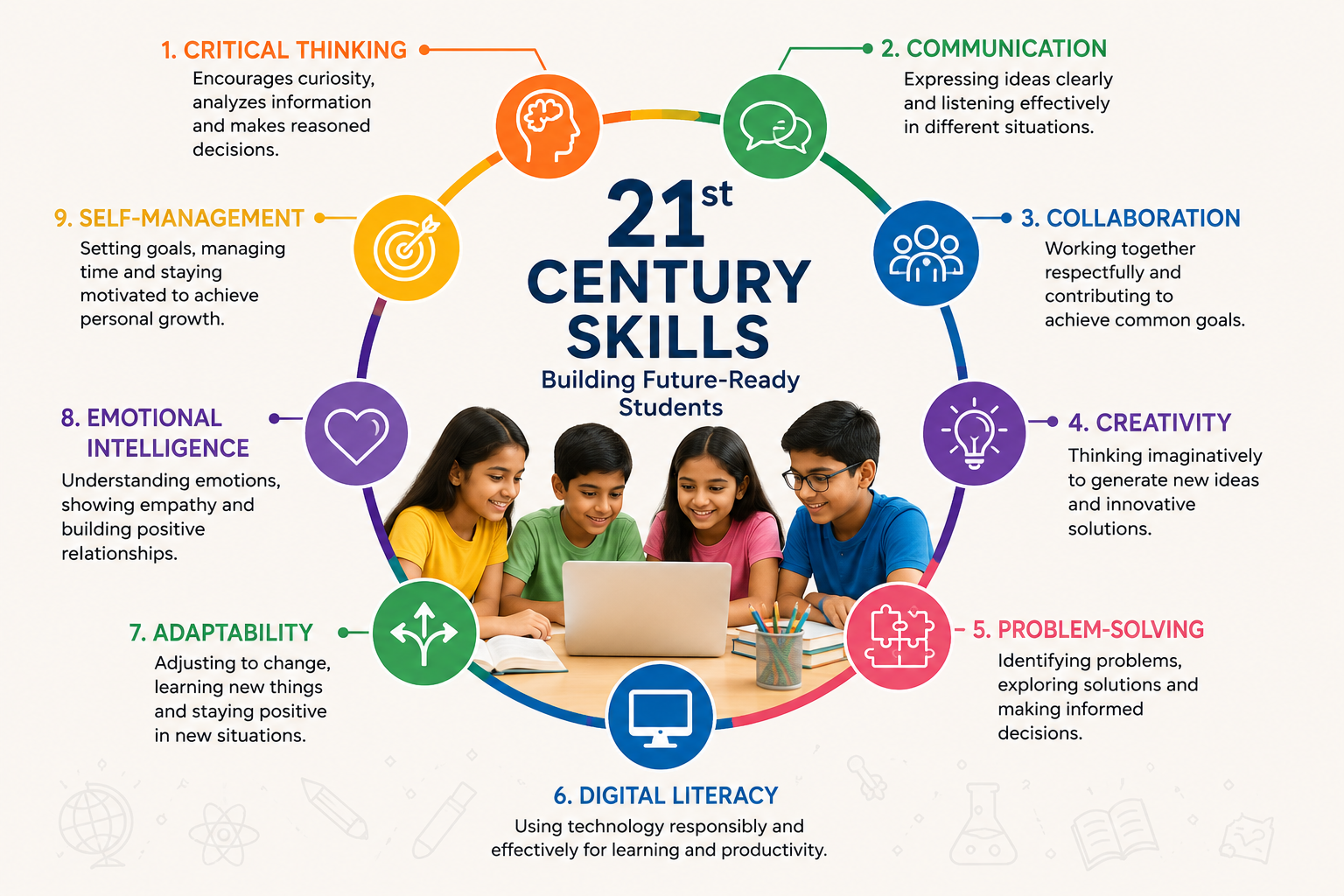
Skill | How It Helps Students |
Critical thinking | Helps students evaluate information and make thoughtful decisions |
Communication | Helps students express and understand ideas |
Collaboration | Helps students work effectively with others |
Creativity | Encourages new ideas and different approaches |
Problem-solving | Helps students handle challenges |
Digital literacy | Supports responsible and effective technology use |
Adaptability | Helps students respond to change |
Emotional intelligence | Helps students understand emotions and perspectives |
Self-management | Encourages independence and responsibility |
These skills should not be viewed as nine separate boxes to tick.
In real learning situations, they often overlap. A student completing a science project might need to research information, question evidence, work with classmates, develop a creative solution and present the final result.
That is 21st Century Learning in practice.
How Can Schools Develop 21st Century Skills?
Students cannot develop these abilities simply by memorising definitions.
They need opportunities to practise them.
A school can encourage 21st Century Learning through activities such as:
Project-based learning
Students investigate a topic, explore questions and work towards an outcome.
Collaborative activities
Group work gives students opportunities to communicate, share responsibilities and listen to different perspectives.
Experiential learning
Connecting classroom concepts with real-world experiences can make learning more meaningful.
Classroom discussions
Open discussions encourage children to explain their reasoning and consider different viewpoints.
Creative activities
Art, design, drama, writing and open-ended projects can encourage students to explore ideas.
Reflection
Asking students what they learned, what challenged them and what they could do differently can develop self-awareness and independent learning.
What Should Parents Look for in a Future-Ready School?
When comparing schools in Bengaluru or schools in Kanakapura, parents may naturally consider academic results, curriculum and facilities.
Those factors matter, but it can also be useful to look at how children actually learn.
Ask whether students get opportunities to:
- Ask questions
- Participate in projects
- Work in teams
- Present their ideas
- Solve practical problems
- Explore creative interests
- Use technology meaningfully
- Learn from mistakes
- Participate in sports and co-curricular activities
- Connect classroom lessons with everyday situations
A school does not need to use the phrase “21st Century Skills” in every lesson. What matters is whether its learning environment gives children genuine opportunities to practise these abilities.
Common Mistakes When Developing Future Skills for Students
Focusing only on marks
Academic achievement is important, but it should not become the only measure of a child’s development.
Giving answers too quickly
When children face an age-appropriate problem, giving them the solution immediately can remove an opportunity to think independently.
Treating creativity as only an art activity
Creative thinking can happen in mathematics, science, languages and everyday problem-solving too.
Being afraid of mistakes
A mistake can become useful when children are encouraged to understand what happened and think about what they can do differently.
Using technology without purpose
Technology should support learning rather than become the learning objective itself.
Simple Ways Parents Can Build 21st Century Skills at Home
Parents do not need expensive programmes or complicated activities to support future-ready learning.
Everyday life offers plenty of opportunities.
Instead of asking only, “What answer did you get?”, ask your child, “How did you arrive at that answer?”
When planning a family activity, allow children to contribute ideas.
If your child faces a small problem, give them time to suggest possible solutions before stepping in.
Reading together can also become an opportunity for discussion. Ask what your child thinks about a character’s decision or whether they would have handled a situation differently.
Hobbies can help too. Reading, sports, music, drawing, puzzles, coding, building activities and creative projects can all provide opportunities to practise different skills.
The important thing is not to turn every activity into a lesson.
Children also need space to explore, play and simply be curious.
How Edify School Supports Future-Focused Learning
For parents exploring CBSE schools in Bengaluru, understanding a school’s approach to learning can be just as important as looking at its curriculum structure.
Edify School’s 3C Curriculum is built around Content, Competence and Character. According to the school’s published information, its competency focus includes areas such as critical thinking, problem-solving, collaboration and digital literacy.
The school’s curriculum information also highlights opportunities connected with creativity, communication, decision-making and problem-solving.
This kind of approach illustrates how academic knowledge can be combined with broader competencies and character development.
For parents in Bengaluru and around Kanakapura Road, looking closely at how a school translates its educational philosophy into classroom experiences can help when comparing options.
Who Can Benefit from 21st Century Skills?
Every student can benefit from developing these abilities.
However, the way they are introduced should depend on the child’s age and developmental stage.
For younger children, skill development may begin with simple activities such as sharing, listening, asking questions, following routines and solving small problems.
Older students can gradually work on more complex projects, independent research, presentations, teamwork and decision-making.
The goal is not to make children grow up too quickly.
It is to help them gradually become confident learners who can think for themselves while knowing when to ask for help.
When Should Parents Seek Additional Support?
Skill development normally happens through a combination of school, family life, hobbies and everyday experiences.
However, if a child consistently struggles with communication, organisation, participation, concentration or adapting to new learning situations, parents can speak with the child’s teacher.
A teacher can help parents understand the context of the difficulty and suggest appropriate strategies or additional support where needed.
The earlier a concern is discussed, the easier it can be to understand what kind of support may be useful.
Preparing Students for a Changing Future
No one can predict exactly what the world of work or education will look like several years from now.
That is precisely why students need skills that can transfer from one situation to another.
21st Century Skills help children do more than remember information. They help them question, communicate, collaborate, create, solve problems and respond to change.
Academic knowledge remains the foundation, but students also need opportunities to use that knowledge in meaningful ways.
For parents considering schools in Bengaluru, Kanakapura or elsewhere in Karnataka, it is worth asking a simple question:
Is my child’s education preparing them only for the next examination, or also helping them become a confident lifelong learner?
Edify School’s focus on Content, Competence and Character offers parents one approach to consider when exploring future-focused education.
If you would like to learn more about Edify School and its admission process, enquire now.
Frequently Asked Questions About 21st Century Skills
1. What are 21st Century Skills?
21st Century Skills are abilities that help students apply knowledge effectively in academic, personal and real-world situations. They include critical thinking, communication, collaboration, creativity, problem-solving, digital literacy, adaptability, emotional intelligence and self-management.
2. Why are 21st Century Skills important for students?
These skills help students do more than memorise information. They support students in analysing information, communicating ideas, working with others, solving unfamiliar problems and adapting to changing situations. They complement academic knowledge and can contribute to more independent and confident learning.
3. What are the most important skills students need for the future?
Important Future Skills for Students include critical thinking, communication, collaboration, creativity, problem-solving, digital literacy, adaptability, emotional intelligence and self-management. The relative importance of each skill can vary according to a student’s age, interests and future learning goals.
4. How can schools develop 21st Century Skills?
Schools can develop these abilities through project work, classroom discussions, group activities, experiments, creative tasks, presentations, technology-enabled learning and real-world problem-solving. The key is to give students regular opportunities to practise skills rather than simply explaining their importance.
5. How can parents develop 21st Century Skills at home?
Parents can encourage these skills through everyday activities. Ask children to explain their thinking, involve them in age-appropriate decisions, encourage reading and discussion, provide opportunities for creative activities and allow them to work through manageable problems independently.
6. Is digital literacy a 21st Century Skill?
Yes. Digital literacy is an important part of modern learning. It involves more than knowing how to operate devices. Students should also learn how to find and evaluate information, communicate responsibly online, protect their privacy and use digital tools appropriately.
 Admission Form
 Talk to Counsellor
 WhatsApp
 Email
 Location


